




Downhill Longboards


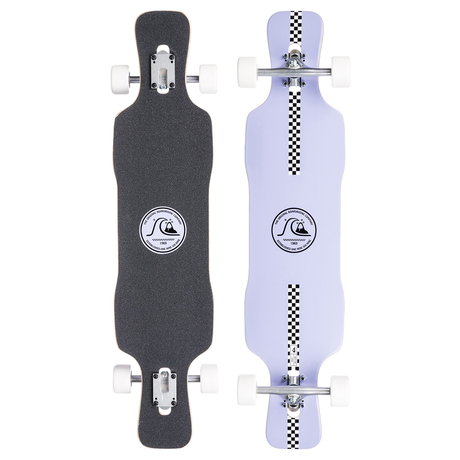
Downhill longboards for speed, control and safety
Downhill boards are built for high speed, sharp turns and maximum stability on steep slopes. Here you’ll find a curated selection of downhill boards designed to keep you in control when the pace really picks up. Decks, trucks, wheels and bushing setups are fine-tuned for speed and stability rather than tricks or casual cruising.
Whether you’re tackling technical downhill runs with powerful slides or chasing top speed on long descents, construction plays a vital role in both performance and safety. That’s why it’s important to choose a board that suits your riding style, skill level and the type of terrain you plan to ride.
How to choose a downhill board: key parameters
A good downhill setup is about balancing stability, responsiveness and grip. Here are some of the key factors to consider when comparing boards:
- Deck shape and flex Most downhill decks are stiff with very little flex to prevent instability at high speeds and to ensure precise control.
- Wheelbase (distance between trucks) A longer wheelbase, usually between 65–75 cm, provides more stability, while a shorter one makes the board more lively but also a bit twitchier at high speed.
- Truck angle and width Low angles, around 40–45°, and wider trucks keep the board steady, while higher angles turn quicker but may feel unstable when going downhill.
- Wheel size and durometer Large wheels, 70–75 mm, roll more smoothly over rough surfaces, and slightly softer urethane provides better grip, while harder wheels make sliding easier.
- Griptape and concave Coarse griptape combined with a deep concave or foot pockets help lock your feet in place so you can maintain position in corners and during slides.
- Bushings and stability Stiffer bushings and properly tightened kingpins minimise wobble and make the board more predictable at higher speeds.
It’s the combination of these elements that determines whether the board feels solid at 40–60 km/h and if you have the precise control required for safe slides and emergency braking.
Types of downhill setups and terrain choice
Downhill boards can generally be divided between platforms built purely for speed and hybrids that also suit freeride. Classic downhill decks often have a lower centre of gravity, such as micro-drop or drop-through designs, for extra stability, while topmount decks provide the most grip and direct steering.
For technical downhill with plenty of hairpin turns and slides, many riders choose a setup between freeride and downhill: a topmount deck, distinct concave, medium to hard wheels and a truck setup that allows both carving and controlled slides. For fast, open descents focused on pure speed, the priority is maximum stability: a longer wheelbase, wider trucks, stiff bushings and grippy wheels.
Terrain matters too. On rough country roads, slightly larger wheels and a setup that can handle small stones and cracks are really helpful. If you’re riding on smooth mountain roads abroad, you can go for harder wheels and stiffer trucks since the road surface is more predictable.
Level, safety and practical use
Downhill is a high-risk discipline, and safety should always come first. Ideally, you should already have solid skateboarding experience and feel confident with slides and speed control before you take on serious downhill riding. If you’re intermediate, start with gentler slopes, softer wheels and a more forgiving setup that makes it easier to practise braking techniques.
Protective gear is a must: a full-face or downhill-specific helmet, gloves with pucks, knee and elbow pads, and durable clothing are strongly recommended. Always skate familiar routes with clear visibility, check the road surface for holes and gravel, and never ride faster than you can safely stop within your visible distance.
In everyday use, a downhill board can also work for travelling longer, faster distances where you want smooth rolling and reliable grip, but it’s not the best choice for short commutes or city cruising. Choose it mainly if you’re focused on hills, speed and controlled slides.
Once you’ve identified your level, terrain and preferred speed, you can select a downhill board from our range and build a setup that matches your style and gives you confidence on every descent.